Be yourself; Everyone else is already taken.
— Oscar Wilde.
This is the first post on my new blog. I’m just getting this new blog going, so stay tuned for more. Subscribe below to get notified when I post new updates.
Be yourself; Everyone else is already taken.
— Oscar Wilde.
This is the first post on my new blog. I’m just getting this new blog going, so stay tuned for more. Subscribe below to get notified when I post new updates.
Week 12 blog: Gamification
On week 12 public relations class we learned about what is gamification and watched Ted: gamification to prove our world, according to Ted x talks (2014) discussed when we talk about games, people always thinking about games is for people get relaxed, games for child or games for those people that like stay home don’t work or some ‘single big boys’, but the games are now changed, games do not just play for fun, it can be used in education and even business. The gamification is now a very powerful tool. For example, in ted talk Yu-Kai talk about how the gamification is used in education, he discussed that when we are young, almost everyone doesn’t like learn math, so someone developed a game is about dragon, the player needs to eliminate all the item around the dragon, the way to eliminate these items is by using math, like negative plus positive can be zero. When children play, they just want to get 3 stars and help the dragon, but they also learned math. This is a very good example of what is gamification.
There is a lot of examples about how game used in education, according to Kingsley and Hagen (2015) the reason why that gamification can be used in education is because whatever in real or virtual world, game always can motivate students to complete tasks, some of them even can help to build the ability of communication and group work, cause the when they playing games they usually will focus on how to get 100 percent reward or collect full stars, so they will be very interested in the game but they also learned. Gamification also can use to help people keep their health like there is a game called zombie run and pokemon go, there two games need player walk or run in real life like if you don’t want to be bitten by zombie, you need to keep walking sometimes you need run when the zombie is so close to you. Another one is if you won’t catch the pokemon you like or powerful pokemon, then you need to go to the location and catch them. These are two examples that gamification used differently.
Gamification also can be used in business. For example, there is a game about collect car, it’s like player need go to someplace to collect a car on his phone, then he needs to run for another player, if he can keep the car for a week then he can get a real car, this is a very good example about how to use gamification in business, cause for now everyone can have a car, it’s not a big news, but by games car company makes it become a news and be publicized by people to people. Speak of gamification, there is another example that I can discuss, but it is just my thinking, the example is when I am studying public relations, my lecture say to us ‘every student that comes on time every class can get 5 extra marks, it’s like a reward, student comes to class on time is very normally thing, but not too much student follow the rules, but with the marks, everything is different, just for me, I won’t get the 5 extra marks so I will go to class on time.
Reference list:
Ted talks 2014, Gamification to prove our world: Yu-kai Chou at TEDxLausanne, video, YouTube, 27 February, viewed 16 January 2020,
<https://www.youtube.com/watch?v=v5Qjuegtiyc>
Kingsley, TL & Grabner‐Hagen, MM 2015, ‘Gamification’, Journal of Adolescent & Adult Literacy, vol. 59, no. 1, pp. 51–61.
Week 11 blog: Bangkok cafe owner slammed for trying to sell items used by guest Blackpink singer Lisa
We watched a few news during the week 11 class, and one of them caught my attention. According to Straitstimes (2020): One day Lisa, a singer of the well-known Korean girl group Blackpink, spent her time at Bangkok Cafe. But then the coffee shop owner sold items used by Lisa online including spoons, coffee cups, and even toilet bowls that she used. After this, the coffee shop owner received a lot of replies from Lisa’s fans. People are getting angry with what the coffee shop owner did, they think the coffee shop owner didn’t respect Lisa at all, after this, the coffee shop owner apologized to the public and said he liked and respected Lisa as much as her fans. This is not the first time those kinds of things happened, according to Straitstimes (2020), before someone also sold a chopstick that used by Canada singer Chris Wu, but the different thing between those two-story is the chopstick has been sold, and people have not got so angry with this.
So the reason why when a product has been used by celebrity, then it can be sold by a very high price or can get a lot of attention can be explained by Albert and Ambroise and Florence (2017)’s research, when some brand is suggested by a celebrity, the brand’s volume of sales will increase. This is because celebrities can be trusted by the public. If we change the brand to the items that celebrities used, this will be the same, but like the news said before, the reason why these two similar news story ends so different, in my own opinion, first is because they sell different product, the owner of the coffee sells the item that Lisa close used like the coffee cup they were touch by Lisa’s lips and the toilet bowls, it’s so different than just a chopstick that Chris Wu’s hands touched. This is one of the reasons why Lisa’s fans so angry with this because it’s kind of behavior that has some sexual implications and is very disrespectful to people.
Another reason that people getting so angry is that the price is so high, even though those items are been used by a celebrity, but to be honest it just trash, of course, I am not talking about the coffee cup and the spoons but toilet bowls, this is useless. In my opinion, I don’t think no one wants to buy these items, the main reason that people getting so angry is because the price, if the price is a little bit lower, maybe the story will end a different way. Overall the coffee shop owner has his right to sell these items cause these items to belong to him, but he shouldn’t have done that cause this is a very disrespecting way to people even after he said he sorry for what he did, but the cost of his behavior is irreversible.
Reference list:
straitstimes 2020, Straitimes 5 January 2020, viewed 15 January 2020,
Albert, N, Ambroise, L & Valette-Florence, P 2017, ‘Consumer, brand, celebrity: Which congruency produces effective celebrity endorsements?’, Journal of Business Research, vol. 81, pp. 96–106.
Week 10 blog: Non-profit sector
In week 10 class we discussed what is the non-profit sector and what is the issues of the non-profit sector. According to Salamon and Anheier (1997), the definition of the non-profit sector is organizations that are not for personal or organizational profit are often referred to as the non-profit sector. For my understanding is organizations that serve the general public and do not make money from it. For example charities, advocacy groups, professional bodies, and foundations, etc. Non-profit sector can target multiple areas, such as health, education, religion, and environment. The issues of the non-profit sector are managing the sector and how to tell the public what is the organization’s service.
By using Kidsafe Australia (2019) as an example I will be analyzing how the non-profit sector can tell the public about the information and services about their organizations, according to Harvill (2010, pp. 49-60) semiotic theory covers all things that can be regarded as signs. The three elements of semiotics are the sign, the interpretant, and the object. Semiotic can tell audiences the information by using pictures and words, use semiotics can bring readers a more intuitive and successful information reception rate. The piece of evidence is below:

This is the logo of kidsafe Australia organizations, cause they are working on child safety so throw the logo we can see they using cute animal as word like rabbit, duck, giraffe to present K, D, F and the little I between rabbit and duck looks like a child sitting in the middle of the animals, it will make audience feel that they do care about children, cause this make me feel that they want to give every child a soft and colorful childhood. They using the cute animals and colorful words to design a such cute logo to show that how much they care about child, for the children audiences they would love to have communication with this organization and will be easy to trust them, and for adult audiences can give them a message that how much they care about their child, in my opinion, this logo is very attractive for me and an easy to catch peoples emotional. Another piece of evidence is the website’s home page:
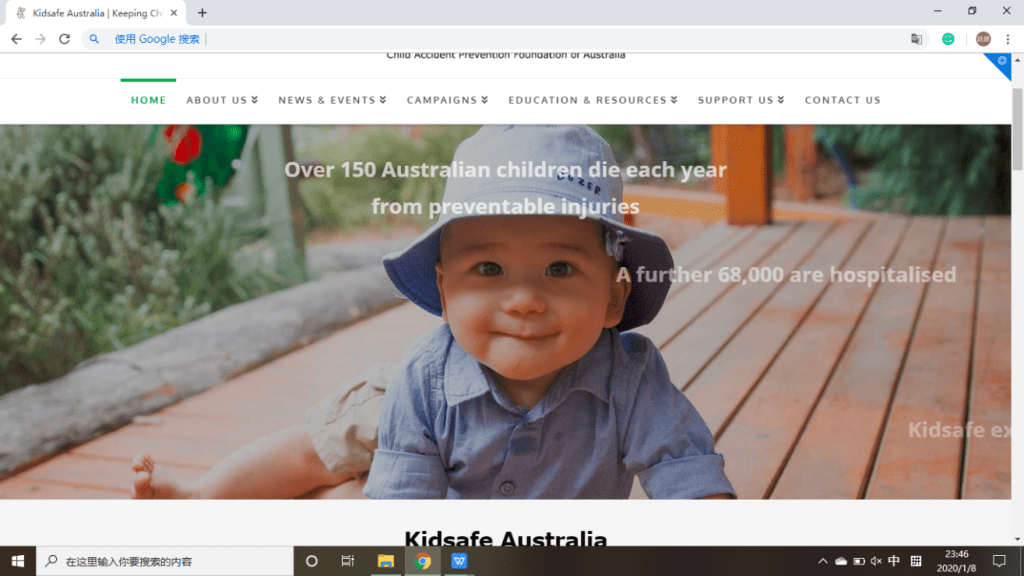
On the home page, we can see that they put on a baby’s photo at the top of the home page and there has a sentence says “over 150 Australian children die each year from preventable injuries. A further 68,000 are hospitalized”, this would be making audiences have strong feelings, they using a cute baby’s picture but with a horrible word, two different feelings cross together, will make audiences thinking about what they can do something to help these baby. So people will donate or become a volunteer at this organizations, this is a very good example of how the non-profit sector can tell the public about what they are doing and for those non-profit sectors, gain people’s trust is a very important thing for them, cause this is what they can get support form peoples.
Reference Lists:
Kidsafe Australia 2019, Kidsafe Australia, n.d., viewed 20 December 2019,
<http//:kidsafe.com.au>
Harvill, N 2010, ‘Use the Purpose by Which All May Benefit: The Semiotics of ‘Public Use’’, International Journal for the Semiotics of Law – Revue Internationale de Sémiotique Juridique, vol. 23, no. 1, pp. 49–60.
Salamon, L.M. & Anheier, H.K., 1997. Defining the nonprofit sector: A cross-national analysis (Vol. 3). Manchester University Press.
Week 9 blog: Guns with history
Preventgunviolence (2015) discussed over 60% of Americans think having a gun will be more safety then does not have a gun, but the truth is having a gun will increase the risk of homicide, suicide, and unintentional death. To tell people this fact, Preventgunviolence (2015) chose to tell the group in different ways. The video shows that they opened a gun shop in New York City, with hundreds of guns and all guns have their own history. Then they put a hidden camera all over the shop. When people came here to buy guns, they will tell every buyer the history of each gun, the history is a record of every gun used to kill, including the shooter and who has been killed. They use the story to warning everyone who wants to buy a gun, telling them to have a gun will not increase personal safety.
This video is very successful that making audiences start to think about owning a gun is a good thing or bad thing. Because they using emotional appeals theory to let audiences resonate emotionally. According to Stucki and Sager (2018, pp. 373-385), emotion is one of the most effective and persuasive ways to transmit information. No matter the positive emotion of negative emotion. It can make people have certain actions of power. Because people’s behavior is based on emotion, when the information publisher wants the readers to agree with their idea or act in the direction they want, the information publisher can use different emotions to influence the readers.
For example, in this video, they tell people the history of the guns, the horrible history, most people will feel fear, shock, and sadness, then people will think did they really need a gun or not, and they use a lot of close-up shot on people’s face, every people in that store are making very exaggerated face, some person open their eyes and mouth very big feel so shocked, some of them are reacting very sad. By shows their facial expression can be better communicated to those who watch the video, the audiences can very easy to get the emotional power through their faces. The strong emotional power can make people resonates emotionally. Especially when the end of the video they did a quick interview with those buyers, one of them said that she still knows to have a gun it’s her rights, but in another way, she didn’t want to have a gun at home. She thinks owning a gun can not be more safety than doesn’t own a gun. This is the best part of the video. This woman’s word can give readers the last blow.
The video use emotional appeals theory to make audiences understand the gun issues, and then they interviewed the buyers, let them tell audiences owning a gun maybe are not a safe way to protect themselves.
Reference list
Stucki, I & Sager, F 2018, ‘Aristotelian framing: logos, ethos, pathos and the use of evidence in policy frames’, Policy Sciences, vol. 51, no. 3, pp. 373–385.
Preventgunviolence 2015, Guns with history, video, YouTube, 17 March, viewed 11 December 2019,
This is an example post, originally published as part of Blogging University. Enroll in one of our ten programs, and start your blog right.
You’re going to publish a post today. Don’t worry about how your blog looks. Don’t worry if you haven’t given it a name yet, or you’re feeling overwhelmed. Just click the “New Post” button, and tell us why you’re here.
Why do this?
The post can be short or long, a personal intro to your life or a bloggy mission statement, a manifesto for the future or a simple outline of your the types of things you hope to publish.
To help you get started, here are a few questions:
You’re not locked into any of this; one of the wonderful things about blogs is how they constantly evolve as we learn, grow, and interact with one another — but it’s good to know where and why you started, and articulating your goals may just give you a few other post ideas.
Can’t think how to get started? Just write the first thing that pops into your head. Anne Lamott, author of a book on writing we love, says that you need to give yourself permission to write a “crappy first draft”. Anne makes a great point — just start writing, and worry about editing it later.
When you’re ready to publish, give your post three to five tags that describe your blog’s focus — writing, photography, fiction, parenting, food, cars, movies, sports, whatever. These tags will help others who care about your topics find you in the Reader. Make sure one of the tags is “zerotohero,” so other new bloggers can find you, too.

 PR assignment 3 week 9 blog